40 by 30 is our Environmental Impact commitment.
A non-negotiable target of 40% reduction in absolute co2 emissions by 2030, 40 by 30 is not just a logo, but a mindset. A determination to actively decrease our reliance on carbon, and to reduce our overall co2 emissions as a result. A combination of behavioural training, innovation and investment to reduce the impact of our activities on the planet.
Benchmark and Approach
40 by 30 targets an absolute reduction in scope 1&2 CO2 emissions by our business. No offsetting included, no turnover-weighting. As we grow, we’re committed to doing it while still reducing carbon emissions. And to do this, we need a benchmark. 2021 was chosen to be our benchmark year following the COVID-19 pandemic’s impact on industrial output. Using dates covered by a global decrease in activity would skew the progress figures, so the first subsequent “normal” year was chosen instead. An approach unified across our global VINCI family this allows direct comparison of impacts, and supports shared learning with clarity.
Soil Engineering Geoservices’ approach has been behaviour-led from the start. As a business the major causes of carbon consumption in our day to day activities are plant and vehicle use. Being a predominantly site-based business means that both areas of activity are key to delivering our clients’ needs, so while the activities need to remain, their carbon footprint has to be reduced. With the application of solutions including Hydrogen-based power and HVO being initially challenging due to our work locations, we started the process by looking at how we choose to use fuels overall, aiming to reduce business-wide consumption even if the fuel is low-carbon.
Key Steps towards 40 by 30
Decarbonised Facilities
We removed oil-fired heating from our main office, replaced it with an electrical solution, and signed “green energy only” supply deals for all our fixed premises.
Increased Efficiency HGV Use
The transport team took ownership of haulage emissions. Chiefly through supporting improved communication and collaboration between sites, they reduced the number of empty HGV movements by over 25%.
Technical innovation
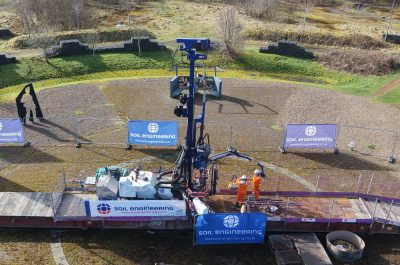
The Plant Department invested in extensive research and development. Rather than rely just on our ongoing plant renewals programme to reduce engine emissions, they looked at off-the-shelf retrofit solutions to improve the performance of the existing fleet. While adopting new performance monitoring systems allowed more timely engineering interventions, a hydrogen injection system also reduced fuel input needs. Once applied to both rigs and vehicles after extensive trials, the hydrogen system saw reductions of over 10% in fuel consumption.
Driver Behaviour
We invested in Lightfoot vehicle monitoring technology. This has supported changes in driver behaviour, resulting in more gentle driving styles. This approach uses significantly less fuel, as well as promoting road-user safety.
Current Position
Having seen a significant decrease in overall fuel consumption across the business, and an increase in the reliable availability of alternatives, we have made further steps forward. In 2025 our grouting division made a wholesale step away from conventional diesel fuel. Thereafter their operations have been consciously shifted to being HVO-led. Subsequently, in January 2026 our ground investigation operations switched to nationally prioritising HVO as their fuel source wherever possible. Despite the market price differential, our steps to reduce fuel consumption has helped mitigating this cost factor for our clients. Of course, as a responsible buyer we only source HVO from certified sources.
A drive to decrease the number of internal combustion engine (ICE) vehicles in our fleet is ongoing. Our default position for all company cars is electric first. Whenever an ICE vehicle is requested, a business case is now required for justification. Simultaneously, trials of electric commercial vehicles are ongoing. Obviously the remote nature of some of our works makes this an additional challenge.
Progress Against our 40 by 30 Target
As of June 2026 we have reduced our scope 1&2 CO2 emissions and are on track to achieve the 40 by 30 target.
Our efforts in adopting technology to reduce fuel demand was recognised by industry in the 2025 Ground Engineering Awards.
Our drilling fleet renewal programme continues.
Because we know this is not just our problem, we continue to share learning across our sector and within our wider group.
We aim to support our clients in reducing the embodied carbon of their own works through continued collaboration, best practice, innovation and technical input.